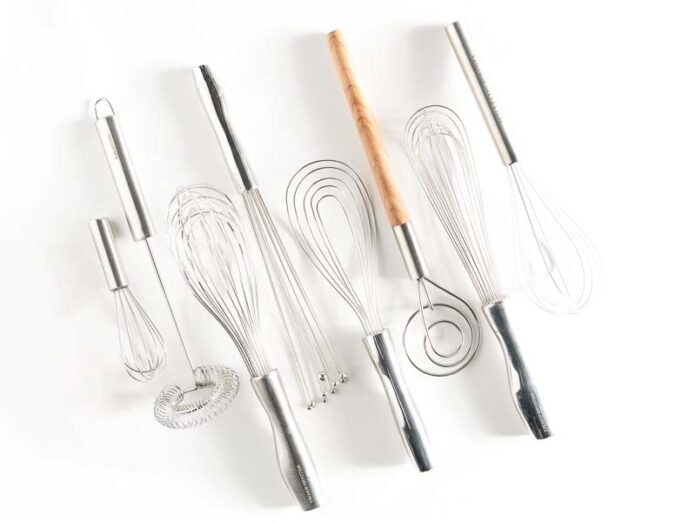
Every whisk looks like wires on a handle, but each has its own specialty. Some add air, some smooth out lumps, and others muscle through thick doughs. Choosing the right whisk can mean the difference between dense cake and fluffy sponge, clumpy custard and satiny cream. Here’s our guide to the whisks that deserve a spot in your kitchen and what they do best.
BALLOON WHISK: The Drama Queen
With its wide, round head, this is the whisk that puts on a show. It pulls in plenty of air, making it essential for whipping egg whites into meringue and cream into clouds or lightening cake batters. Whenever “airy and voluminous” is the goal, the balloon whisk delivers. We love to use it to fold fluffy egg whites into sponges. It’s the one most bakers picture when they hear the word “whisk,” and for good reason—it’s a classic.
FRENCH WHISK: The Sophisticate
Think of it as the refined cousin of the balloon whisk—longer, slimmer, and narrower. Instead of whipping in big pockets of air, the French whisk excels at gentle, thorough mixing. Use it to blend dry ingredients into wet batters, smooth out cake mixtures, or create silky ganache and custards. It’s especially good for emulsifying delicate mixtures where a balloon whisk would be too aggressive. For bakers who love precision, this is the whisk that keeps things smooth, glossy, and just right.
FLAT WHISK: The Pan Whisperer
Shaped like a balloon whisk that’s been pressed flat, this one keeps its wires in contact with the bottom and sides of the pan. That makes it perfect for baking tasks like stirring lemon curd, custards, or pudding bases, where every bit of the mixture needs to stay silky-smooth. It’s also helpful for gently folding flour into sponge batters, ensuring no pockets are left behind without adding excess air.
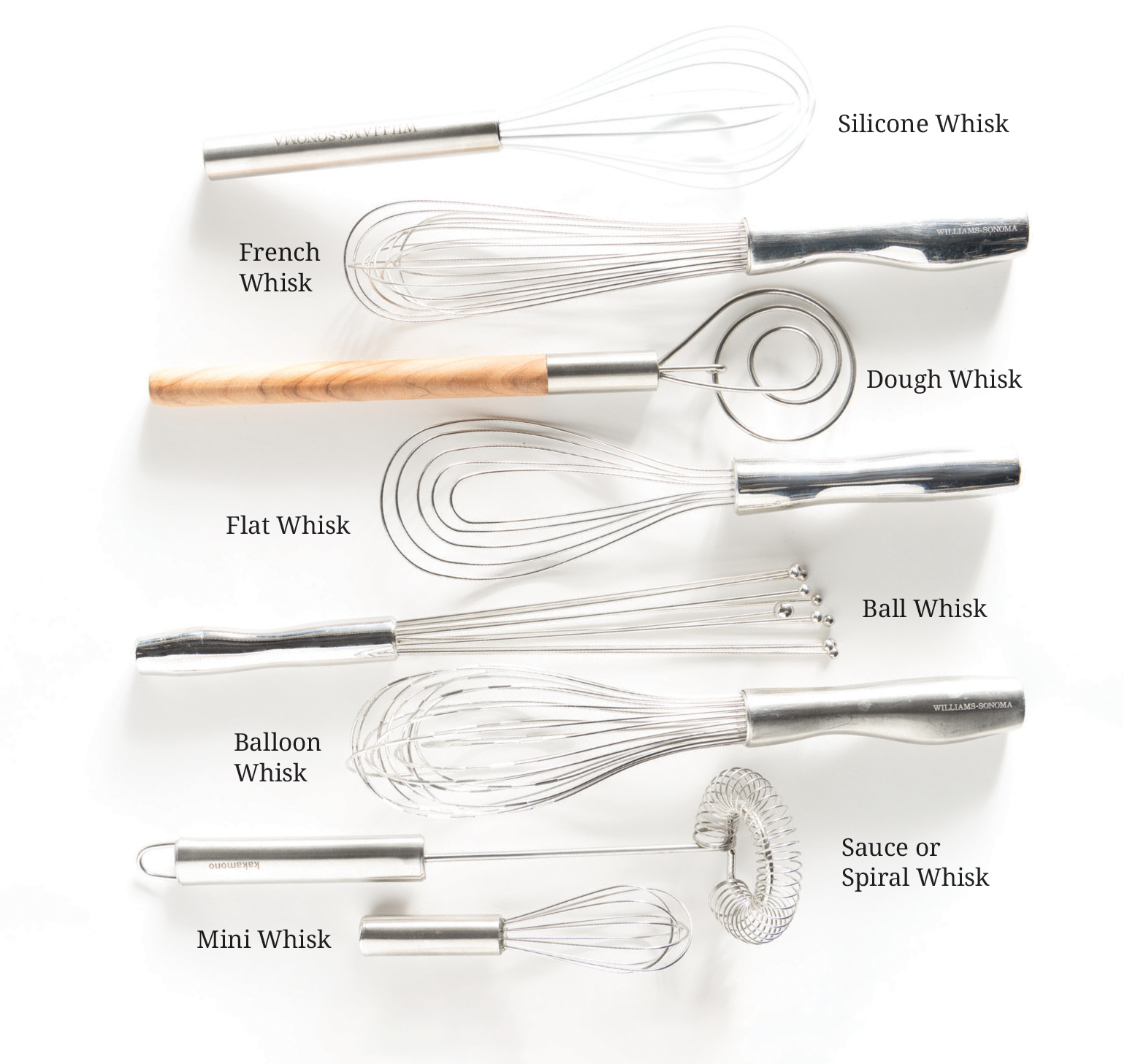
Sturdy, open loops make this whisk the go-to for heavy hitters: bread doughs, biscuits, and scones. Unlike a spoon that strains against thick dough, the dough whisk cuts right through, blending flour and liquid with less effort. It mixes evenly without overworking gluten, so breads rise tall and scones stay tender. Because dough doesn’t cling to its wires the way it does to spoons or spatulas, cleanup is easy, too. Once you try it, you’ll never mix a rustic dough any other way.
SAUCE OR SPIRAL WHISK: The Corner-Scraper
With a coiled head that bounces against the pan, this whisk is designed to keep mixtures moving. In baking, that means lump-free pastry cream, pudding, or lemon curd. Its spiral shape makes constant contact with the pan, so nothing scorches or clings. If you’ve ever had streaky custard, this whisk is your insurance policy.
BALL WHISK: The Pancake Pro
This modern-looking whisk trades loops for straight wires tipped with little balls. The design slips through batters with ease, breaking up lumps without overmixing. That makes it ideal for pancake batter—it eliminates clumps while avoiding too much air, which can make pancakes tough instead of tender. It’s also surprisingly effective at blending cocoa into liquid or smoothing out chocolate sauces.
SILICONE WHISK: The Gentle One
A whisk with a soft side. Its silicone coating makes it safe for delicate cookware (especially nonstick), but it’s just as useful for bakers. Reach for it when making pastry cream, pudding, or custard directly in a saucepan—it stirs smoothly without scratching. It’s also great for whipping small batches of cream or beating eggs when you want to protect your bowl from wear.
MINI WHISK: The Pocket-Size Overachiever
Small but mighty, this whisk is perfect for the little jobs. We love it for whisking together dry ingredients—flour with cocoa, spices with sugar—when a full-size whisk feels clumsy. It’s also ideal for stirring up a quick glaze, beating a single egg, or even mixing up hot cocoa directly in the mug. It may look like a novelty, but you’ll reach for it constantly.