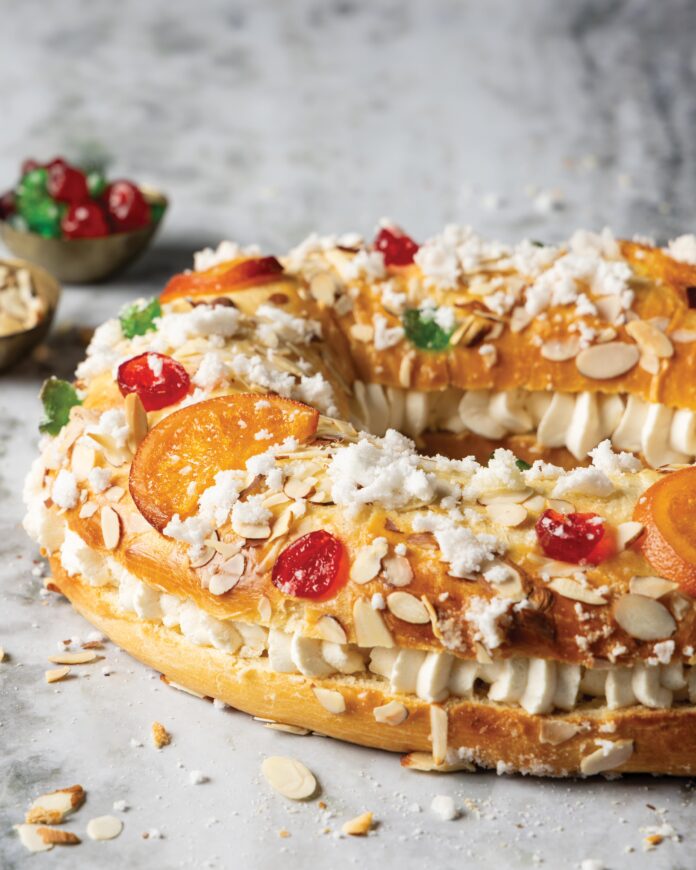
The tradition of slicing into a beautiful and delicious king cake is one that transcends cultures and ages. There are many names for the cakes that are traditionally enjoyed during Epiphany and the pre-Lenten season; in Spain and other Spanish-speaking countries, it’s roscón de reyes, which translates to “king’s cake” or “three kings’ bread.” Although every aspect of this cake, from the jewel-like candied fruits to the circular shape, resembles a crown fit for royalty, its history and traditions began in a time before kings.
The ancient Roman festival of Saturnalia, which occurred over several days in December to honor Saturn, the Roman god of agriculture, abundance, and renewal, was filled with parties and feasts. Cakes with a bean or coin hidden inside were prepared, and whoever received the slice containing the object would be crowned “king of the day” and was allowed to request anything they wanted.

As the Roman Empire expanded and evolved, the cake and its traditions fell out of favor, especially when Christianity became its official religion. It wasn’t until the Middle Ages when a king cake bearing resemblance to the Roman version made its return in Europe. In this time, Christmas celebrations began on December 25 and lasted until January 5. On the final day, also called Twelfth Night, a “bean cake” would be served, and as during Saturnalia, the recipient of the bean hidden inside would be crowned “king of the day.”
Over time, the tradition of king cake became tied more closely to Epiphany, which marks the arrival of the three Magi in Bethlehem to visit baby Jesus and bestow gifts upon him. In France, during the reign of King Louis XV, from 1715 to 1774, the galette des rois became increasingly popular, with the bean inside being replaced with a gold coin. King Felipe V of Spain, who ruled from 1700 to 1746, brought king cake into fashion in his country. Though still called cake, roscón de reyes is a bread that’s shaped into an oval or a circle, which represents of the eternal nature of God and God’s never-ending love, and decorated with dried or candied fruits that symbolize the crown of the Magi, and a coin is hidden inside that symbolizes baby Jesus.
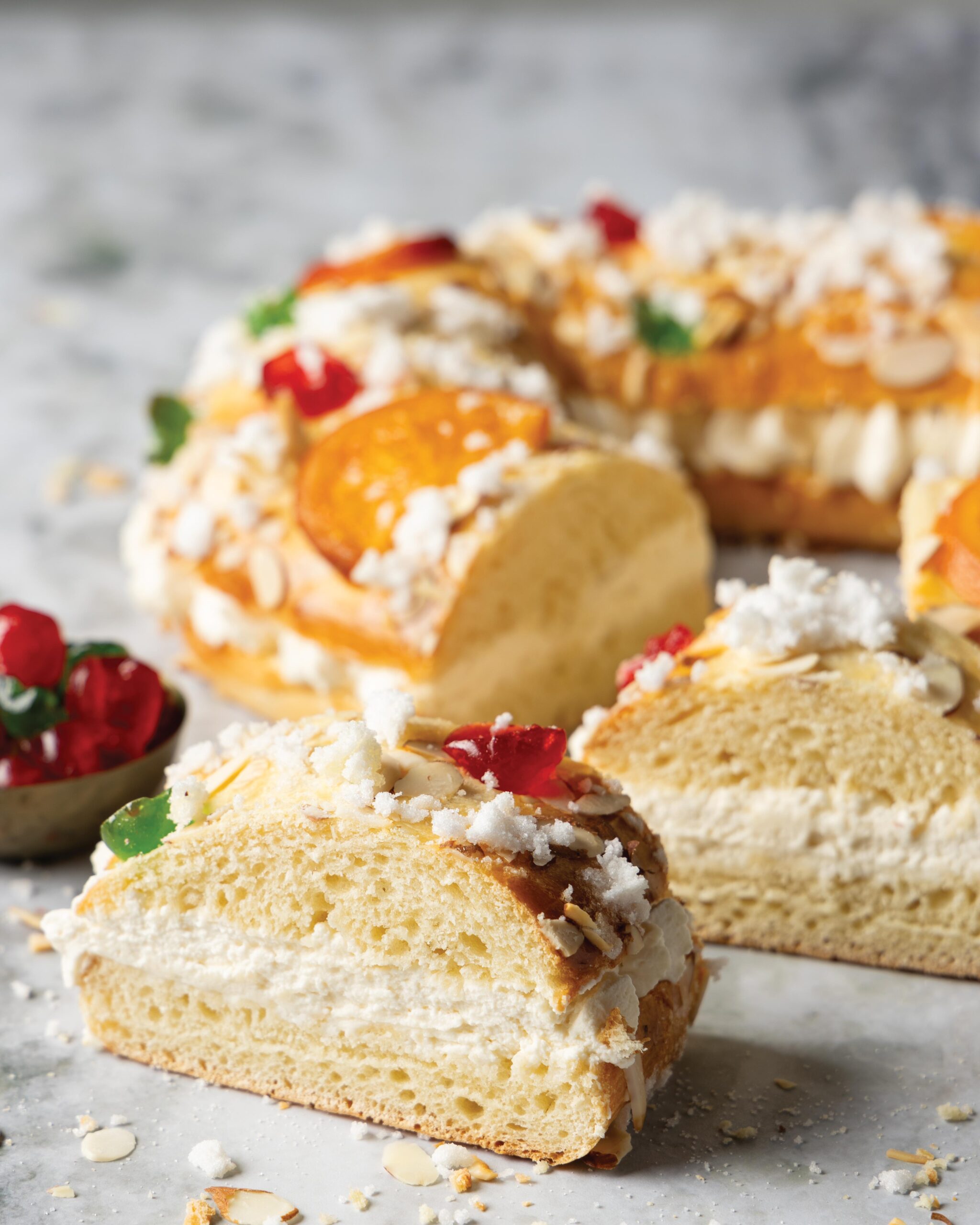
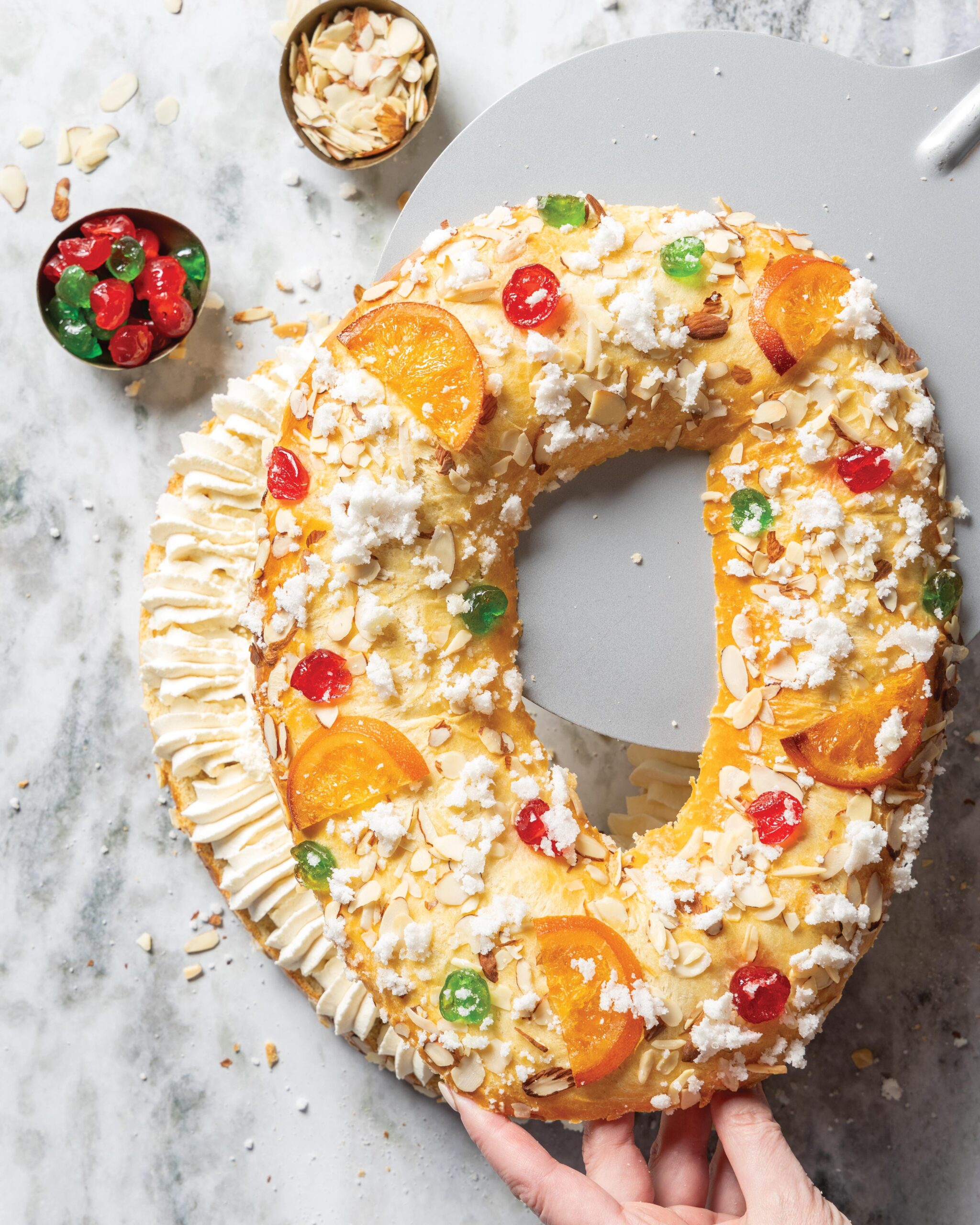 Some families believe every aspect of this cake holds symbolic meaning, from the shape to the knife used to cut it, which symbolizes the danger Jesus faced and his persecution. Hiding a bean inside the roscón eventually came back into fashion in addition to the coin. Whoever found the coin was crowned king and the person who found the bean was called el tonto del haba, or “the bean fool,” and had to provide the cake the following year. Modern versions substitute the coin with a small figurine of Jesus or of a king, and most still include a dried bean. The most traditional filling is whipped cream, though some families opt for a fruit jam instead.
The love of the roscón de reyes spread to Latin America as Spanish settlers spread their traditions, and today, many nations in Central and South America have their own versions and traditions. Argentine custom is to forgo adding a bean or figurines and the roscón is topped with a pastry cream and candied cherries or figs. In Mexico, their roscón follows the Spanish version closely, though there are usually four toppings to symbolize the four cardinal points, one of which is typically a crackled strip of sugary dough similar to craquelin or the topping of a concha, a Mexican sweet bread. Additionally, Mexican families don’t include a bean, and the winner of the figurine has the honor of hosting the party and providing tamales for Día de la Candelaria, or Candlemas, on February 2.
Today, the roscón is enjoyed by households all over Spain on Epiphany, or Día de los Reyes Magos. As you decide how you want to celebrate this year, consider taking part in this tradition that has deliciously evolved over a few millennia.
Roscón de Reyes
Ingredients
Dough:
- 3½ cups (445 grams) bread flour, divided, plus more for dusting
- ½ cup plus 2 tablespoons (124 grams) granulated sugar, divided
- 1 (0.25-ounce) packet (7 grams) active dry yeast*
- ½ cup (120 grams) warm whole milk (105°F/41°C to 110°F/43°C)
- ¼ cup (60 grams) warm water (105°F/41°C to 110°F/43°C)
- 3 large eggs (150 grams), room temperature and divided
- ⅓ cup (75 grams) unsalted butter, melted and cooled slightly
- 1 tablespoon (15 grams) water
- ⅓ cup (38 grams) sliced almonds
- Candied fruit, for topping
- ½ teaspoon (2.5 grams) orange blossom water (see Notes)
Filling:
- 4 ounces (113 grams) cream cheese, softened
- ¼ cup (30 grams) confectioners’ sugar
- ½ teaspoon (2 grams) vanilla extract
- 1½ cups (360 grams) cold heavy whipping cream
Instructions
- For dough: In a medium bowl, whisk together 1 cup (127 grams) flour, 1 tablespoon (12 grams) granulated sugar, and yeast. Stir in warm milk and ¼ cup (60 grams) warm water until a paste forms. Cover and let rest in a warm, draft-free place (75°F/24°C) until bubbly, 15 to 20 minutes.
- In the bowl of a stand mixer, stir together 5 tablespoons (60 grams) granulated sugar, kosher salt, and remaining 2½ cups (318 grams) flour by hand. Add yeast mixture, 2 eggs (100 grams), and melted butter. Using the paddle attachment, beat at low speed until combined and a shaggy dough forms, 2 to 3 minutes.
- Switch to the dough hook attachment. Beat at medium-low speed until a smooth, slightly tacky dough forms, 10 to 12 minutes.
- Spray a large bowl with cooking spray. Place dough in bowl, turning to grease top. Cover and let rise in a warm, draft-free place (75°F/24°C) until doubled in size, about 1½ hours.
- Punch dough down, and turn out onto a lightly floured surface. Roll dough into a long rectangle, about 24x6 inches, with one long side closest to you. Starting with one long side, roll up dough into a tight log, pinching seams to seal. (See Notes.)
- Line a rimmed baking sheet with parchment paper. Place dough log, seam side down, on prepared pan, joining ends to form a ring. Pinch ends to seal, using water as needed. Cover with plastic wrap, and let rise in a warm, draft-free place (75°F/24°C) until puffed, 1 to 1½ hours.
- Preheat oven to 350°F (180°C).
- In a small bowl, whisk together 1 tablespoon (15 grams) water and remaining 1 egg (50 grams). Brush egg wash evenly over dough. Decorate as desired with sliced almonds and candied fruit, gently pressing to adhere.
- In another small bowl, stir together orange blossom water and remaining ¼ cup (50 grams) granulated sugar until sugar is fragrant. Sprinkle sugar mixture on top of dough.
- Bake until bread is golden brown and an instant-read thermometer inserted in center registers at least 190°F (88°C), about 30 minutes. Let cool on pan for 10 minutes. Remove from pan, and let cool completely on a wire rack.
- For filling: In the bowl of a stand mixer fitted with the whisk attachment, beat cream cheese, confectioners’ sugar, and vanilla at medium-high speed until smooth. With mixer on medium speed, gradually add cold cream, beating until combined. Thoroughly scrape sides of bowl. Beat at medium-high speed until thick and stiff peaks form, 2 to 3 minutes. Spoon filling into a pastry bag fitted with a large open star piping tip (Ateco #827).
- Using a large serrated knife, cut loaf in half horizontally. Place bottom half on a serving dish. Pipe filling onto bottom half as desired. Place top half on filling. Refrigerate in an airtight container for up to 3 days.