

Recipe by Sawako, Fait Beau Tokyo
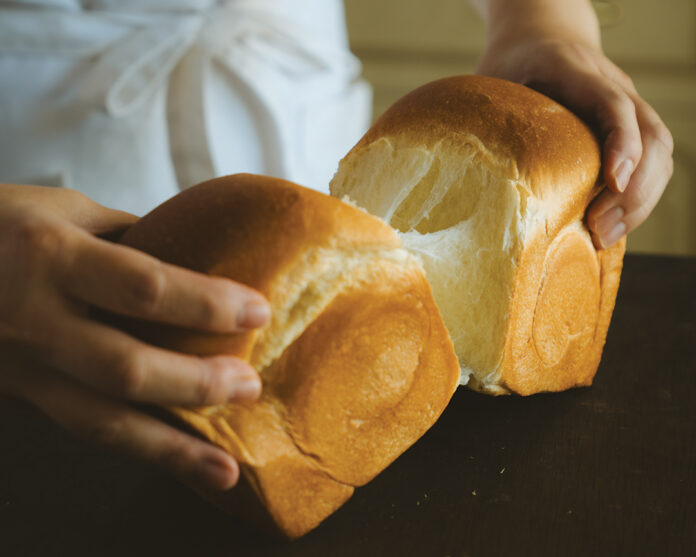
Shokupan’s softness comes from a balance of fat, hydration, and patient gluten development. The dough starts simply but transforms as it’s kneaded, shifting from sticky to beautifully elastic. Folded, rolled, and baked snugly in the pan, the loaves pull apart with a thin, almost paper-like sheet that is a signature of this bread.
Shokupan
Ingredients
- 250 grams bread flour
- 20 grams sugar
- 5 grams salt
- 3 grams instant yeast
- 85 grams water
- 80 grams milk
- 20 grams double cream
- 15 grams butter
Instructions
- Put all the ingredients except the butter into the bowl of stand mixer with the dough hook attachment. Mix on low speed until dough becomes strong and gluten has developed, 40 to 45 minutes. [Dough should pass the windowpane test; see Notes.]
- Add the butter and continue kneading until well combined.
- Let it rise until doubled in size.
- Remove the dough and gently press the top with your hand to release the gas. Divide into 2 equal portions (about 218 grams each), and shape each into a ball. Cover with a cloth and let rest at room temperature for 15 minutes.
- Roll out each dough ball with a rolling pin into a rectangle, about 23x13cm (9x5 inches).
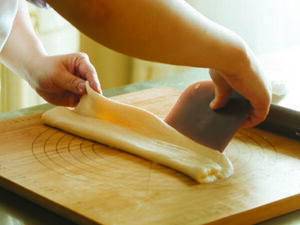
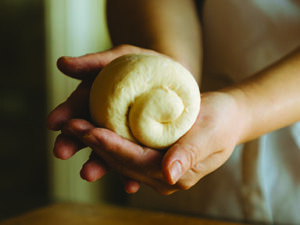
- For each dough ball, fold in both sides (about one-fourth of the width) toward the center, then roll it up from one end [see photos below].
- Place the two rolled doughs into the loaf pan, positioning them along the edges if desired. Cover with plastic wrap and proof at 35°C (95°F) for 45 to 60 minutes or until the dough rises to about 1.5cm (1/2 inch) below the top of the pan.
- Bake in a preheated oven at 200°C (390°F) for 30 minutes or until golden brown. After baking, take the pan out of the oven and firmly tap it on the table while still in the pan. This helps release the steam trapped inside the bread, preventing it from shrinking when you remove it from the pan.
Notes
Recipe Testing Notes
- Bake from Scratch swapped a 7¾x3¾-inch loaf pan for 18x9cm loaf pan; Bob’s Red Mill Bread Flour for Japanese bread flour; and heavy whipping cream for double cream.
- All ingredients should be room temperature.
- For windowpane test, lightly flour hands and pinch off (don’t tear) a small piece of dough. Slowly pull the dough out from the center. If dough is ready, you’ll be able to stretch it until it’s thin and translucent like a windowpane. If dough tears, knead it for 1 minute more and test again.
- Let dough rise covered, in a greased bowl, in a warm draft-free place (75°F/24°C).
- Cover bread with foil during the final 10 to 15 minutes of baking to prevent excess browning if necessary.
Tried this recipe?Let us know how it was!
Fait Beau Tokyo welcomes students from around the world. Classes are taught in English and Japanese, from beginner roll cakes to the coveted four-day Master Course. Follow her gentle, detail-driven baking on Instagram at @tokyobaking.



The magazine is missing the yeast in the list of ingredients.
Hi Shannon,
We accidentally omitted 3 grams instant yeast from the Shokupan recipe in the issue. The fully corrected recipe is now live above, so you can bake this soft, pull-apart milk bread exactly as intended. We apologize for the error. Happy baking!
The recipe in the magazine does not have yeast in the ingredients! Guess what? It didn’t work. I am very disappointed!
Hi Linda,
We accidentally omitted 3 grams instant yeast from the Shokupan recipe in the issue. The fully corrected recipe is now live above, so you can bake this soft, pull-apart milk bread exactly as intended. We apologize for the error. Happy baking!
I’d like to buy another copy of the latest issue. How do I do that? It’s for a dear friend who lives in Japan.
Hi Katherine,
You can purchase an additional copy of our new issue here: https://bakefromscratch.com/product/january-february-2026/
Would whipping cream work in place of double cream? I don’t think double cream is usually in US grocery stores.
Hi,
Heavy cream is the same as double cream, so that will work! Happy baking!
45 minutes of kneading? I fear my kitchenaid would burn up. Is this the truth or should it read 4-5 minutes? Actually neither seem likely
Hi Lisa,
A KitchenAid won’t blow up, because it is set to the lowest speed. We would check the dough for windowpane at 30 minutes before letting it go all the way to the 45 minute mark. Hope this helps and happy baking!
Seems as though the photos are misleading. This bakes a much smaller loaf than pictured. Reference picture for the folding part looks larger than 9×5. Also, should the pan be greased? It was difficult to remove the loaf from the pan without running a knife around several times. Is it possible to double the recipe to make a larger loaf and use a 9×5 pan?
Hi Kari,
We have not tested this recipe doubled, but based off of the measurements, a double recipe likely would not fit in a 9×5. You could try doing a 1.5 times batch in a 9×5 pan, which could change the baking time. Happy baking!
Bread looks amazing ing and I’d like to try making it. How is it used in Japan? Is it cut and used for sandwiches? Pulled apart and served like a dinner roll? Other than looking beautiful, how best is this bread utilized?
Hi Amy,
Shokupan is used as an everyday bread in Japan. It is very versatile and can be used any way you would like. Happy baking!
40-45 minutes of stand mixer kneading? Is that right?
Hi,
Yes, the 40-45 minutes is correct. Happy baking!
This recipe is great, but needs a little refinement for the average baker.
The loaf is small, so baking in a standard pan doesn’t work really well. Likewise, the mini load pans don’t give the two halves the nice soft line between them. My answer was to 1.5 times the recipe and use a standard loaf pan. Instead of two little loaves, you get three and do the exact same thing.
Otherwise, the long mixer gluten development makes for a super easy recipe and a nice fluffy loaf. It’s hard to overproof this too. I ended up proofing at room temp for 4-5 hours.
What would happen if you made this without a mixer? Do the Japanese stir the dough for 40-45 minutes with a wooden spoon? When you e.mailed corrections, I was sure that this would be the culprit! My KitchenAid is 50 years old. It might not survive; stirring dough for 45 minutes by hand, I might not survive!
Hi Arlene! If you do not want to use a stand mixer, you could always knead by hand. Our chefs originally tested the recipe by hand-kneading; however, it took approximately one hour to pass the windowpane test due to the high fat content in the dough (which inhibits gluten development, thus making the knead time longer). Sawako’s original recipe was developed using a bread maker, but we felt it would be easier for our readers to use a stand mixer, as bread mixers can vary greatly depending on brands, and are not as versatile in our opinion.