Sfogliatelle
Makes about 24 pastries Sfogliatelle, meaning “thin layer” or“thin leaf,” are divine pastries from the Campania region of Italy. Be sure to plan ahead, as this recipe requires time and patience to roll, measure, cut, shape, and fill the pastries into their classic shell-like shape. Once you have one bite, all your hard work will be well worth it as the layers of flaky, golden pastry crackle into a million shards, revealing the creamy, custardy semolina-ricotta filling inside.They’re best enjoyed warm (alongside a cappuccino, by Neapolitan standards),as they lose their irresistible crispness over time.
Equipment Needed


Ingredients
Dough:
- 4 cups (508 grams) bread flour
- 2 teaspoons (6 grams) kosher salt
- 3/4 cup plus 3 tablespoons (225 grams) water
- 1 tablespoon (21 grams) honey
- All-purpose flour, for dusting
- 8 ounces (227 grams) lard
Filling:
- 1 cup (240 grams) whole milk, room temperature
- 1/2 cup (100 grams) granulated sugar
- 2/3 cup (120 grams) semolina flour
- 1/4 teaspoon kosher salt
- 2 cups (450 grams) whole-milk ricotta cheese*
- 1 large egg yolk (19 grams), room temperature
- 1 teaspoon (4 grams) vanilla extract
- 1/2 teaspoon (1 gram) ground cinnamon
- 1/4 teaspoon ground cardamom
- 3/4 cup (107 grams) chopped candied orange peel
Confectioners’ sugar, for dusting
Instructions
- For dough: In a large bowl, whisk together bread flour and salt. Add 3⁄4 cup plus 3 tablespoons (225 grams) water and honey, and stir until a shaggy dough forms. Turn out onto a clean surface, and knead until dough comes together. (Dough will look a little dry but will hydrate after resting.) Wrap in plastic wrap, and refrigerate for at least 1 hour or up to overnight.
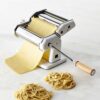
- Divide dough into 4 portions (about 186 grams each). Roll 1 portion of dough through a pasta roller at the largest setting. (Keep remaining portions covered in plastic wrap while you work.) Fold dough into thirds like a letter, and rotate 90 degrees. Repeat rolling, folding, and rotating two more times until dough is smooth and even.
- After third roll, drop to the next level on pasta roller. Continue to roll dough, lowering setting on pasta roller with each pass, until you reach smallest setting. Lay finished dough flat, and lightly dust entire length with all-purpose flour. (Too much flour will dry out dough and it will rip when pulled.) Carefully roll dough onto a small rolling pin to make it easier to handle.
- Unroll about 6 inches of rolled-out dough in front of you. Using your hands, spread a thin, even layer of lard onto dough. Stretch it to 10 to 12 inches wide, or as thin and wide as you possibly can by hand. You should be able to see your hand through the dough. Starting from short side closest to you, roll dough into a tight log. Continue to grease, stretch, and roll dough until you have about 2 inches left. Cover final 2 inches with lard, and stretch out thin.
- Take second portion of dough, and pass it through pasta roller. Repeat flouring and rolling procedure; grease first 2 inches of dough, and stretch to match first portion of rolled-up dough. Overlap the portions, and continue to grease, stretch, and roll second portion. Repeat entire procedure with remaining dough so that all 4 portions of dough are rolled into 1 log.
- Gently compress and roll log to even out the thickness; it should be about 13 inches long. Grease outside of log with lard, wrap tightly in plastic wrap, and refrigerate for at least 1 hour or up to overnight.
- For filling: In a medium saucepan, bring milk and graduated sugar to a low boil over medium heat, stirring occasionally. Stir in semolina and salt; cook, stirring constantly, until mixture thickens and begins to pull away from sides of pan, 1 to 2 minutes. Remove from heat, and let cool for 15 minutes.
- In a large bowl, place semolina mixture. Whisk to loosen and break up large pieces. Add ricotta, egg yolk, vanilla, cinnamon, and cardamom; stir until smooth and combined. Fold in orange peel. Cover with plastic wrap, and refrigerate until cooled, at least 1 hour, or for up to 3 days.
- Preheat oven to 400°F (200°C). Line rimmed baking sheets with parchment paper.
- Spoon cooled filling into a pastry bag, and cut a 1⁄2-inch opening in tip.
- Trim about 1⁄2 inch from each end of dough log. Cut log crosswise into 24 (1⁄2-inch-thick) slices. Working with 1 slice at a time, hold slice so your thumbs are resting in center of slice. Gently press and rotate slice in your hands to create a cone shape, pressing and flattening dough without unwinding it or separating layers. The finished cone should be about 2½ inches in diameter and 3 inches long.
- Holding cone in 1 hand, pipe filling into cone (about 2 tablespoons or 38 grams), making sure to leave 1⁄4 inch of headspace at top. Pinch together ends of cone to seal, and place on a prepared pan. Gently press on pastry to flatten. Repeat with remaining slices and remaining filling, placing 2 inches apart on prepared pans.
- Bake until golden brown, 20 to 25 minutes, rotating pans halfway through baking. Let cool on pans for 5 minutes. Generously dust with confectioners’ sugar. Best served warm. Store in an airtight container for up to 2 days.
Notes
*We used BelGioioso® Ricotta con Latte® Cheese.
Tried this recipe?Let us know how it was!